Category: Public Service Announcement

  • CPSC Warns Consumers to Immediately Stop Using Girasol Wrap Your Baby Sling Carriers Due to Failure to Meet Federal Safety Standard; Fall Hazard

    WASHINGTON, D.C. – The U.S. Consumer Product Safety Commission (CPSC) is warning consumers to immediately stop using Girasol Rainbow Love Woven Wrap sling carriers because they do not comply with the federal safety standard for sling carriers and infants can fall out of them. CPSC also urges consumers to avoid similar products from Girasol because they likely pose the same risk.

    CPSC testing revealed the Girasol Rainbow Love Sling Wrap carriers fail to meet the federal safety standard for sling carriers, including requirements for structural integrity and occupant retention. Additionally, the instructions contain incomplete warning statements required for the sling carriers. Sling carriers manufactured after January 30, 2018, are subject to the mandatory federal safety standard.

    The importer Baby Earthling LLC (d/b/a Wrap Your Baby), of Mountainair, New Mexico, has not agreed to recall the sling carriers.

    These sling carriers were sold online at www.wrapyourbaby.com until November 2022 for between $120 and $165. The carriers are made of a woven cotton fabric in a rainbow print that starts with red on one end, then orange, yellow, green, blue, indigo and ending with violet on the other end. The sling carriers were in sizes 5 to 9, 2.60 meters to 6 meters (8.5 feet to 19.6 feet) and are intended for infants weighing between 8 and 35 pounds.

    CPSC is aware of other similar Girasol sling carriers offered for sale online at www.wrapyourbaby.com in the following models: Girasol Sherwood Woven Wrap Carrier, Girasol Rainbow Baby Woven Wrap, Barefoot Rainbow Girasol Woven Wrap, Sunshine Rainbow Girasol Woven Wrap, Girasol Atlantis Woven Wrap, Girasol Ocean Rain Woven Wrap, Girasol Wisteria Purple Woven Wrap, and Girasol Earth Woven Wrap but has not specifically tested the safety of those carriers, for which test samples are not currently available.

    CPSC urges consumers to stop using the sling carriers, cut the wraps to prevent future use, and dispose of the product. Report any incidents involving injury or product defect to CPSC at www.SaferProducts.gov.

    Individual Commissioners may have statements related to this topic.  Please visit www.cpsc.gov/commissioners to search for statements related to this or other topics.

  • CPSC Warns Consumers to Immediately Stop Using Momaid Infant Loungers Due to Suffocation Risk and Fall Hazard; Failure to Meet Infant Sleep Product Safety Requirements

    WASHINGTON, D.C. – The U.S. Consumer Product Safety Commission (CPSC) is warning consumers to immediately stop using Momaid infant loungers because they do not comply with federal safety standards for infant sleep products, posing a risk of suffocation and a fall hazard to infants.

    The loungers fail to meet the safety requirements of CPSC’s Infant Sleep Products Rule because they do not have a stand. In addition, the lounger fails to meet the side height, markings and labeling, and instructional literature requirements. These failures create an unsafe sleeping environment for infants. The lounger and its packaging also lack a tracking label containing certain required information, including the date of manufacture.

    The seller, Zhejiang Juster Trading LLC, of China, is not cooperating with the CPSC on a recall of this product and is not offering a remedy to consumers. 

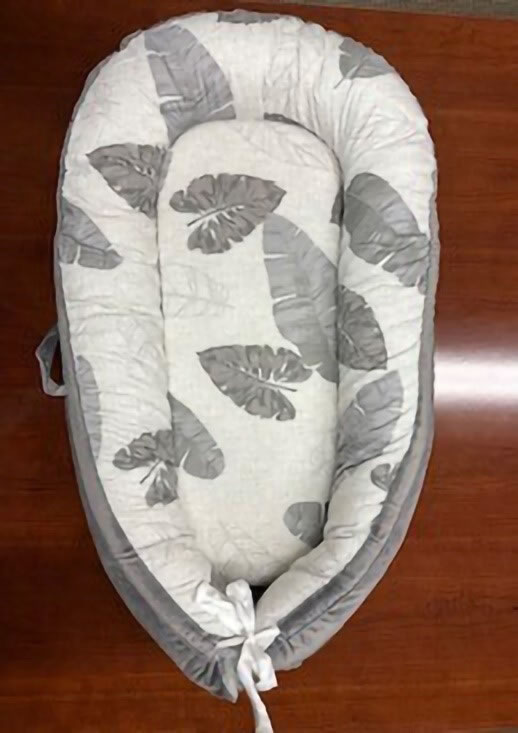
    The infant loungers were advertised as a Baby Lounger Portable Infant Co Sleeping Bassinet Newborn Cocoon Snuggle Reversible Nest Bed Travel Crib. They were sold with a pillow and in four different printed fabrics: Banana Gray Leaf, Blue Palm Leaf, Mint Lychee Leaf and Pink Lychee Leaf. The loungers were sold online at www.amazon.com and other websites for about $55. There is no labeling on the infant loungers. 

    Although the Infant Sleep Products rule is applicable to products manufactured on or after June 23, 2022, CPSC urges firms to consider stopping sale of non-compliant infant sleep products regardless of the date of manufacture. These loungers do not have a required date of manufacture labeled on the product or packaging, and therefore, the CPSC urges consumers to stop using the loungers, cut the fabric, and dispose of the fabric and the pillow immediately. Report any incidents involving product injuries or defects to CPSC at www.SaferProducts.gov.

    Parents and caregivers are reminded:

    • The best place for an infant to sleep is on a firm, flat surface in a crib, bassinet or play yard.
    • Use a fitted sheet only and never add blankets, pillows, padded crib bumpers, or other items to an infant’s sleeping environment.
    • Infants should always be placed to sleep on their back. Infants who fall asleep in an inclined or upright position should be moved to a safe sleep environment with a firm, flat surface such as a crib, bassinet or play yard.
    Momaid Infant Lounger
  • Beware of Products Labeled ‘Antimicrobial’

    By Dr. Mehmet Oz and Dr. Mike Roizen, MDs

    What do credit cards, hockey helmets, kids’ toys, trashcans, toothpaste, deodorants, and shaving creams have in common? They all could contain triclosan, which for a long time has been touted as an effective antimicrobial agent for killing bacteria.

    Then it was discovered that triclosan could contribute to the development of antibiotic-resistant germs — super bugs — and the Food and Drug Administration banned its use in hospital cleaning agents and consumer soaps.

    Unfortunately, the FDA can’t regulate paints, clothes, sporting equipment, or furniture. That’s why you still can find triclosan in those products, as well as anything else that advertises itself as having “antimicrobial properties.”

    And it continues to cause problems, both for the biosphere and for you.

    A study published in the journal Antimicrobial Agents & Chemotherapy revealed how triclosan can help bacteria become more resistant to antibiotic treatments for diseases such as urinary tract infections. Researchers from Washington University in St. Louis found that repeated triclosan exposure makes bacteria able to survive “normally lethal concentrations of antibiotics,” including Cipro.

    Previous research has found that triclosan alters hormone regulation and could be harmful to your immune system.

    Be on your guard for clothing, house paints, toys, etc. that claim to control or kill germs and bacteria. There’s a good chance they contain triclosan. Manufacturers are not required to put that information in their labeling.

    Washing your hands thoroughly with plain soap and water is just as effective at getting rid of unwanted bacteria as so-called antimicrobials.

  • Begin Summer with Safety When Riding ATVs, Around Pools and While Grilling

    Release Date: May 23, 2023

    Release number: 23-209

    WASHINGTON, D.C. – Memorial Day weekend is the traditional kick-off for summer, a time when many people will enjoy more outdoor activities. From riding off-highway vehicles (OHVs), to taking a swim and firing up the grill, the U.S. Consumer Product Safety Commission (CPSC) is reminding consumers of the hazards involved and the steps to help protect themselves and their families, especially children.

    ATV Riding

    All-terrain vehicles are the most popular of the OHVs. They can be a lot of fun, but they can also be dangerous if not used properly. According to CPSC’s latest report, from 2017 through 2019, there were 2,178 deaths associated with OHVs, nearly 70% were ATVs and 283 OHV deaths were children under 16 years old. CPSC estimates that in 2021, there were 106,600 emergency room treated injuries associated with OHVs and 29% were to children under 16 years old. The dangers of riding OHVs are real and include overturning, collisions, and occupant ejection.

    It is important to follow these ATV safety tips to ensure a safe and enjoyable ride. 

    • Training: Get hands-on training from a qualified instructor. 
    • Seats: Never ride with more passengers than there are seats. Most ATVs are designed for one rider. 
    • Stay Off Roads: Stay off paved roads. Never ride on public roads, except to cross, where permitted by law. 
    • No Drinking: Avoid drinking alcohol before or while driving an ATV.
    • Age Limits: Riders younger than 16 should drive only age-appropriate youth models -never adult models. 
    • Safety Gear: Always wear a helmet and other protective gear, such as eye protection, boots, gloves, long pants and a long-sleeved shirt. 

    Pool Safely                 

    A dip in the pool may be a good way to escape the heat, but it is important to remember to stay vigilant when it comes to water safety. From 2017 through 2019, there were an average of 389 yearly pool- or spa-related, fatal drownings involving children younger than 15 years old and in 2021, there were nearly 6,800 nonfatal drowning injuries treated in emergency departments for that age group. Children under 5 years old accounted for 73% of the fatal child drownings. 

    To prevent tragedies from happening at the pool, CPSC recommends following these safety tips:

    • Supervision: Never leave children unattended in or near a pool, and always designate an adult to watch over the pool area.
    • Barriers: Install barriers around the pool, to prevent unsupervised access by children.
    • Swimming Skills: Learn how to swim and teach your child how to swim.
    • Drains: Keep children away from pool drains and ensure that they are properly covered to prevent entrapment.
    • CPR: Learn how to perform CPR on children and adults.
    • See additional pool safety tips and kids pool games at www.poolsafely.gov.

    Outdoor Cooking and Grilling

    Outdoor cooking and grilling are popular summer activities, and while fun and enjoyable, they can also be dangerous if not done with safety in mind. On average, 13 deaths occur every year, and in 2022, there were 5,400 ER-treated injuries associated with grills, burns being the most common.

    Common grilling hazards include fires, burns, and carbon monoxide poisoning. To reduce these risks and have a safe grilling experience, follow some general safety tips.

    • Recalls: Check www.cpsc.gov to see if the grill has been recalled – follow the remedy if recalled.
    • Inspect: Look over the grill and any gas hoses for cracking, brittleness, holes and leaks. Replace, if necessary. 
    • Location: Use grills outside only, in well-ventilated areas and never indoors, in a garage, breezeway, carport, porch or under a surface that will burn. 
    • Starters: Only use appropriate fire starters and only before lighting the fire. Never add liquid fuel after trying to start a fire.
    • Observe: Never leave a hot grill unattended and keep children away from the grill area. 
    • Clean up: Clean your grill with a ball of aluminum foil or nylon brushes, instead of wire grill brushes, to prevent stray wire brush strands from ending up in the food.
    • Extinguishers: Keep a fire extinguisher nearby and make sure that everyone knows how to use it.

    Report any unsafe products or any incidents where someone was hurt by a product to CPSC at SaferProducts.gov.

    Additional Resources:

    Consumer Educational Brochure: Simple Water Safety Steps Save Lives (English / Spanish)
    Charcoal Grill Safety Tips (English & Spanish)

    Individual Commissioners may have statements related to this topic.  Please visit www.cpsc.gov/commissioners to search for statements related to this or other topics.

  • How to Protect Your Family from CO Poisoning and Other Post-Storm Dangers this Hurricane Season

    WASHINGTON, D.C. – June 1 marks the start of the 2023 Atlantic hurricane season. The U.S. Consumer Product Safety Commission (CPSC) is warning consumers about the increased risk of carbon monoxide (CO) poisoning, fires and electric shock after hurricanes and severe storms hit.

    “Hurricanes and major storms in the U.S. have increased in frequency and severity in recent years. This hurricane season may bring widespread destruction that could impact millions of Americans,” said CPSC Chair Alex Hoehn-Saric. “I urge consumers to follow CPSC’s safety tips to prepare ahead of storms to prevent loss of life in a storm’s aftermath.”

    Consumers need to be especially careful when storms knock out electrical power. CO poisoning from gasoline-powered portable generators can kill in minutes. CO is called the invisible killer because it is colorless and odorless. CO poisoning from portable generators can happen so quickly that exposed persons may become unconscious before recognizing the symptoms of nausea, dizziness or weakness.

    An average of nearly 100 consumers die in the U.S. each year from CO poisoning from portable generators, according to CPSC’s latest report on Non-Fire Carbon Monoxide Deaths Associated with the Use of Consumer Products (54-page PDF).

    CPSC data show African Americans are at higher risk of death 

    An earlier CPSC report (38-page PDF) shows that from 2011 through 2021, where race was known, non-Hispanic Black or African Americans accounted for 23 percent of generator-related CO deaths, which is much higher than their share in the U.S. population.

    Consumers should follow these safety tips to protect their families during hurricane season. The Atlantic hurricane season typically lasts from the beginning of June to the end of November.

    Loss of Power—Using a Generator Safely

    • NEVER operate a portable generator inside a home, garage, basement, crawlspace or shed. Opening doors or windows does not provide enough ventilation to prevent the buildup of lethal levels of CO.
    • Operate portable generators outside only, at least 20 feet away from the house, and direct the generator’s exhaust away from the home and any other buildings that someone could enter, while keeping windows and other openings closed in the path of the generator’s exhaust. Do not operate a generator on an outside porch or in a carport. They are too close to the home. 
    • Follow portable generator instructions about electrical shock hazards in inclement weather, which may include use of an NFPA-rated non-combustible generator tent or may state to wait until rain passes.
    • Check that portable generators have been maintained properly, and read and follow the labels, instructions, and warnings on the generator and in the owner’s manual.
    • Look for portable generators that have a CO shut-off safety feature, which is designed to shut the generator off automatically when high levels of CO are present around the generator. These models may be advertised as certified to the latest safety standards for portable generators–PGMA G300-2018 and UL 2201–which are estimated to reduce deaths from CO poisoning by 87% and 100%, respectively. UL 2201 certified models have reduced CO emissions in addition to the CO shut-off feature.

    Check CO and Smoke Alarms

    • Working smoke and CO alarms save lives! Install battery-operated CO alarms or CO alarms with battery backup on each level and outside separate sleeping areas at home. Interconnected CO alarms are best; when one sounds, they all sound. 
    • Make sure smoke alarms are installed on every level and inside each bedroom at home.
    • Test CO and smoke alarms monthly to make sure they are working properly and replace batteries, if needed. Never ignore an alarm when it sounds. Get outside immediately. Then call 911.

    Dangers with Charcoal and Candles

    • Never use charcoal indoors. Burning charcoal in an enclosed space can produce lethal levels of carbon monoxide. Do not cook on a charcoal grill in a garage, even with the garage door open.
    • Use caution when burning candles. Use flashlights or battery-operated candles instead. If using candles, do not burn them on or near anything that can catch fire. Never leave burning candles unattended. Extinguish candles when leaving the room and before sleeping.

    Dangers with Wet Appliances:

    • Look for signs that your appliances have gotten wet. Do not touch wet appliances that are still plugged into an electrical source.
    • Before using your appliances, have a professional or your gas or electric company evaluate them for safety. Replace all gas control valves, electrical wiring, circuit breakers and fuses that have been under water.

    Dangers with Gas Leaks: 

    • If you smell or hear gas leaking, leave your home immediately and contact local gas authorities from outside the home. Do not operate any electronics, such as lights or phone, before leaving.

    CPSC resources:

    PSA – Hurricane Safety Tips (English)

    PSA – Hurricane Safety Tips (Spanish)

    Carbon Monoxide Safety Center

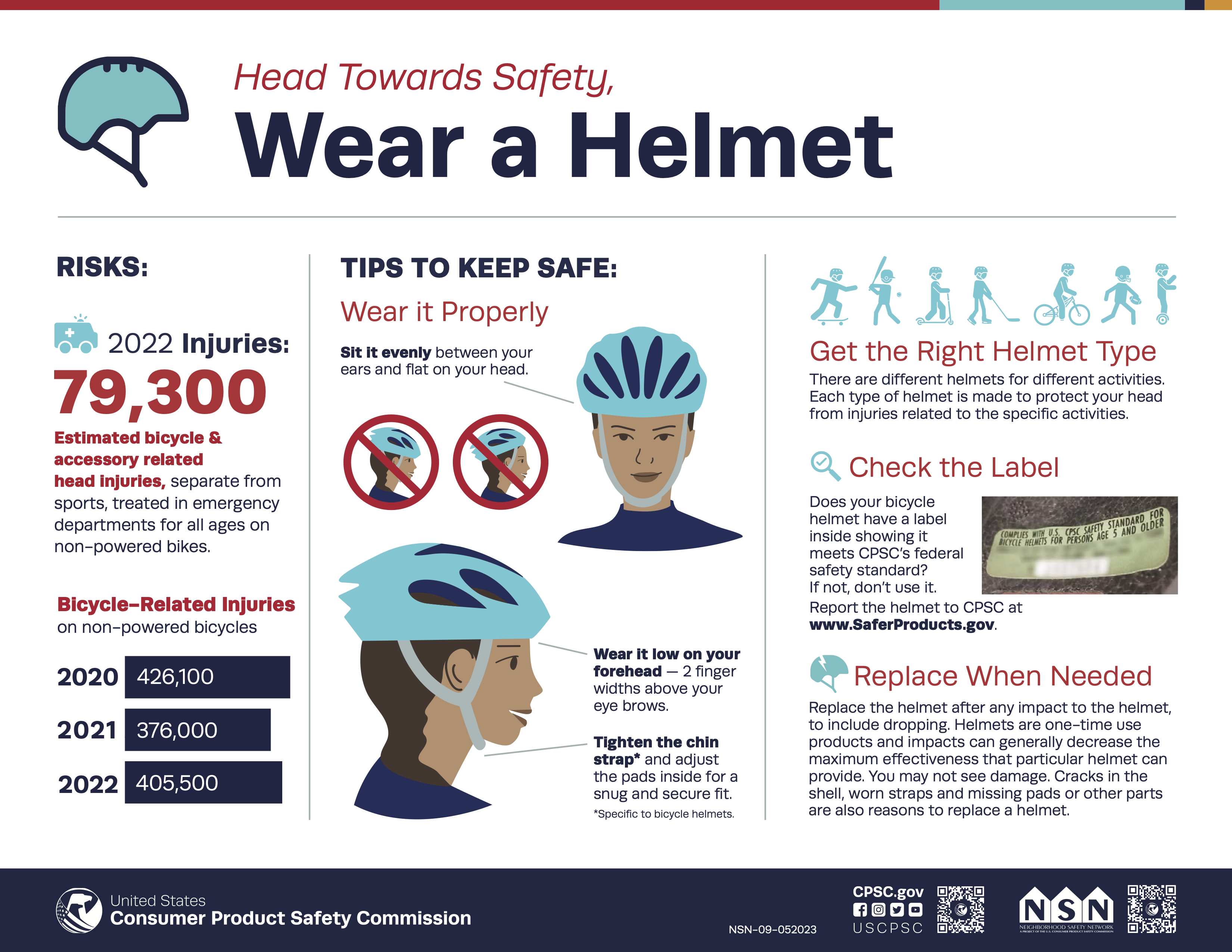
  • Head Towards Safety, Wear a Helmet

    Hi Neighbor!

    May is National Bicycle Safety Month and May 19th is Bike to Work Day. Whether you ride to work or school, hit the trails, or cycle with the whole family, remember to always wear a bike helmet to reduce the risk of injury.    

    Helmets are also essential gear for other sports, including scootering and skateboarding. 

    Did you Know? There were more than 405,000 estimated bicycle-related injuries (non-powered bikes) treated in hospital emergency departments for all ages last year; and more than 79,000 of those were head injuries.  

    Learn more about helmet safety in our “print and share” infographic below.

    Helmet Safety Infographic

  • CPSC Warns Consumers to Immediately Stop Using OKEAH Digital Combination Smoke and Carbon Monoxide Detectors Due to Failure to Alert Consumers to Deadly Carbon Monoxide and Smoke; Sold on Amazon.com

    WASHINGTON, D.C. – The U.S. Consumer Product Safety Commission (CPSC) is warning consumers about the risk of carbon monoxide poisoning and smoke inhalation associated with the use of OKEAH combination smoke and carbon monoxide (CO) detectors. The detectors can fail to alert consumers to the presence of hazardous carbon monoxide and smoke.

    More than 200 people in the United States die every year from accidental, non-fire related CO poisoning associated with consumer products. In addition, most fatalities in residential fires are due to smoke inhalation, rather than heat and flames.  In typical residential fire scenarios, there may be as little as one or two minutes to escape after the smoke alarm sounds before the conditions in the home become incapacitating or deadly. More than 2,390 people in the United States die every year from residential structure fires. Furthermore, the risk of dying in a fire is twice as high in homes without a working smoke alarm (1.18 per 1,000), as compared to homes with smoke alarms (0.53 per 1,000).

    If a combination smoke and CO detector that does not alert to the presence of an elevated level of carbon monoxide or smoke is installed in a home, and carbon monoxide or smoke enters the home, the consumer will not be warned of these harmful conditions, making injury or death very likely. Carbon monoxide sensitivity tests performed on the OKEAH detectors by CPSC found that they failed to alert when exposed to pre-determined concentrations of carbon monoxide (400 ppm), in violation of UL 2034, a voluntary safety standard. The smoke sensitivity test performed on the OKEAH detectors by CPSC found that they failed to alert when exposed to pre-determined concentrations of smoke, in violation of UL 217, a voluntary safety standard.

    The combination detectors are made of white plastic and measure about 4 x 1.5 x 4 inches, featuring a digital display. The combination detectors are advertised to detect dangerous levels of carbon monoxide and smoke and alert with a flashing red LED and a loud alarm pattern. Model No. YJ-901 was sold under the Amazon ASIN B097B63W44 on Amazon.com for between $25 and $75. 

    CPSC urges consumers not to purchase or sell these combination smoke and CO detectors. Stop using them and dispose of these products immediately and install new, working CO detectors. Report a dangerous product or a product-related injury on www.SaferProducts.gov.

    Note: Consumers should install combination smoke and CO detectors on each level of their homes and outside separate sleeping areas. Combination smoke and CO detectors should be battery operated or have battery backup. Test combination smoke and CO detectors frequently and replace batteries as needed. Consumers should only buy combination smoke and CO detectors that meet both the UL 2034 and UL 217 safety standards.

    Individual Commissioners may have statements related to this topic.  Please visit www.cpsc.gov/commissioners to search for statements related to this or other topics.

  • CPSC Warns Consumers to Immediately Stop Using PETRICOR, VARWANEO, and WJZTEK Combination Smoke and Carbon Monoxide Detectors Due to Failure to Alert Consumers to Deadly Smoke; Sold on Amazon.com

    WASHINGTON, D.C. – The U.S. Consumer Product Safety Commission (CPSC) is warning consumers about the risk of smoke inhalation associated with the use of PETRICOR, VARWANEO, and WJZTEK combination smoke and carbon monoxide (CO) detectors. The detectors can fail to alert consumers to the presence of hazardous smoke.

    Most fatalities in residential fires are due to smoke inhalation, rather than heat and flames. In typical residential fire scenarios, there may be as little as one or two minutes to escape after the smoke alarm sounds before the conditions in the home become incapacitating or deadly. More than 2,390 people in the United States die every year from residential structure fires. Furthermore, the risk of dying in a fire is twice as high in homes without a working smoke alarm (1.18 per 1,000), as compared to homes with smoke alarms (0.53 per 1,000).”

    If a combination smoke and CO detector that does not alert to the presence of an elevated level of carbon monoxide or smoke is installed in a home, and carbon monoxide or smoke enters the home, the consumer will not be warned of these harmful conditions, making injury or death very likely. Smoke sensitivity tests performed on the PETRICOR, VARWANEO, and WJZTEK detectors by CPSC found that they failed to alert when exposed to pre-determined concentrations of smoke, in violation of UL 217, a voluntary safety standard.

    The combination detectors are made of white plastic, with approximate dimensions of 4 x 1.5 x 4 inches. The PETRICOR and VARWANEO models feature a digital display. The PETRICOR and WJZTEK models feature a label on the back which lists the model number. The combination detectors are advertised to detect dangerous levels of smoke or carbon monoxide and alert with a flashing red LED and a loud alarm pattern. Model No. MQ-808 was sold under the Amazon ASIN B09DPPFJZJ; and Model No. ACJ-512COM was sold under the Amazon ASIN B0928QZ21C; and Model No. KT-X3 was sold under the Amazon ASIN B07QVC2722 and B07M8LR9M7. The combination smoke and CO detectors were sold on Amazon.com for between $15 and $53. 

    CPSC urges consumers not to purchase or sell these combination smoke and CO detectors. Stop using them and dispose of these products immediately and install new, working CO detectors. Report a dangerous product or a product-related injury on www.SaferProducts.gov.

    Note: Consumers should install combination smoke and CO detectors on each level of their homes and outside separate sleeping areas. Combination smoke and CO detectors should be battery operated or have battery backup. Test combination smoke and CO detectors frequently and replace batteries as needed. Consumers should only buy combination smoke and CO detectors that meet both the UL 2034 and UL 217 safety standards.

    Individual Commissioners may have statements related to this topic.  Please visit www.cpsc.gov/commissioners to search for statements related to this or other topics.

  • CPSC Report Finds 37 Percent Spike in Child Poisoning Deaths in 2021

    March 20, 2023

    From https://www.cpsc.gov/Newsroom/News-Releases/2023/CPSC-Report-Finds-37-Percent-Spike-in-Child-Poisoning-Deaths-in-2021

    Unintentional pediatric poisoning deaths spiked 37 percent in 2021, with 59 children under five years old losing their lives after gaining access to prescribed or illicit drugs. The U.S. Consumer Product Safety Commission (CPSC) encourages consumers to safeguard their families, especially those more vulnerable, from poisonings by taking control of potentially harmful household products, medications and drugs.

    This National Poison Prevention Week (March 20-24, 2023) marks 61 years since the first national observation. Child poisoning deaths have fallen by 73 percent since 1972 due to tough federal laws including the Poison Prevention Packaging Act (PPPA) of 1970 and the Child Nicotine Poisoning Prevention Act of 2015 and the cooperation of the poison prevention community. This community includes the American Association of Poison Control Centers, standard development organizations, consumer advocates, medical professionals, industry and government. 

    “Sadly, this report shows the work that still needs to be done to protect children,” said Alexander Hoehn-Saric, Chair of the U.S. Consumer Product Safety Commission. “Nearly eight out of 10 poisonings occurred in the home. Please take the time to store cleaning supplies, laundry packets, button batteries, and drugs out of children’s reach or in locked cabinets.  If you see it lying around, a child can grab and swallow it.” 

    CPSC’s latest report notes that African American children suffer a higher rate of unintentional pediatric poisoning injuries, 21.4 percent, compared to being 15.8 percent of the U.S. population. The report also found that blood pressure medications, acetaminophen, antidepressants, laundry packets and bleach are the five products most involved in unintentional pediatric poisonings.

    CPSC encourages family members and caregivers to identify hazards in the home that could be a poisoning danger and keep them out of a child’s sight and reach. 


    Safety tips for parents and caregivers:

    Drugs or Medications

    • Keep medications safely stored in a locked cabinet or box and out of the reach of children.
    • Keep medicines in their original child-resistant containers and never in unsecured containers.
    • Properly discard unfinished or unused medicines.

    Laundry Packets

    • Store laundry packets in their original containers and out of a child’s sight and reach.
    • Do not let children handle laundry detergent packets.

    Household Cleaning Supplies

    • Keep chemicals and cleaning supplies safely stored in a locked cabinet or box and out of the reach of children.
    • Keep household chemicals in their original child-resistant containers.

    Button Cell or Coin Batteries

    • Keep products with accessible batteries away from children if the battery compartments do not have a screw closure or if the compartment is damaged. 
    • Check the toys in your home to make sure battery compartments are secured.
    • Do not allow children to play with or be in contact with button cell or coin batteries.

    Individual Commissioners may have statements related to this topic.  Please visit www.cpsc.gov/commissioners to search for statements related to this or other topics.

    Release Number: 23-162