Category: Child Safety

  • Protecting Our Future Starts With Protecting Our Children

    Is your child in the right seat?Keep your littlest passengers safe while in the car…

    Make Sure They Are in #TheRightSeat

    For children ages 1 to 13, motor vehicle crashes are a leading cause of death. In 2015, an average of 2 children were killed and 319 injured every day while riding in cars, SUVs, pickups, and vans. Let’s work together to help spread the word about child passenger safety, and help parents and caregivers choose and use #TheRightSeat.

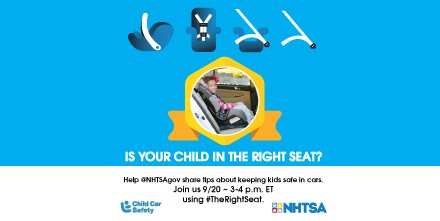
    During Child Passenger Safety Week, NHTSA will host a Twitter Chat where experts will be available to answer your questions. Please help us spread the word and encourage parents and caregivers learn all they can about child passenger safety. We’ve got plenty of resources available to you to help you spread this message to your friends, family, and followers.

    Who: NHTSA and our team of experts

    What: Child Passenger Safety Week Twitter Chat

    When: Wednesday, September 20, 2016, 3 – 4 p.m. ET

    Where: www.twitter.com/NHTSAgov

    How: Follow the conversation using the hashtag #TheRightSeat. Feel free to mention @NHTSAgov in any of your tweets and we will get back to as many questions and comments as we can! Remember to include #TheRightSeat in your comments so others can follow along with the conversation, too.

  • Join CDC’s Upcoming Child Passenger Safety Thunderclap

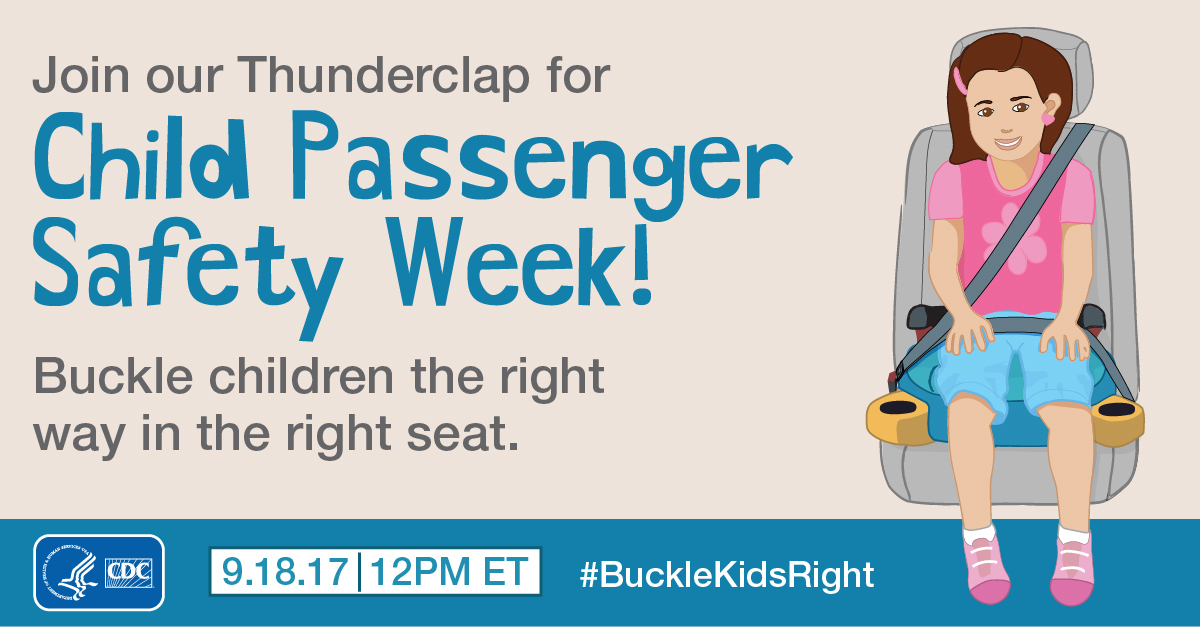
    Join us as we prepare to celebrate Child Passenger Safety Week 2017! Child Passenger Safety Week occurs on September 17-23 and helps raise awareness about the correct use of car seats, booster seats, and seat belts to reduce serious injuries and death among children.

    Car Seat Thunderclap

    Parents want to keep their children safe, but did you know that almost half of car seats and booster seats (46%) are used incorrectly? It is essential that car seats, booster seats and seat belts are installed and used properly, and kids are buckled on every trip.

    Get involved and help us spread the word:

    • Sign up on Thunderclap to share graphics and messages on Facebook or Twitter. By selecting “Support with Facebook” or “Support with Twitter” your account will post this one-time message on September 18th at 12:00 p.m. EST to spread the word about buckling kids the right way in the right seat!
    • Join us all week on social media @CDCInjury to get general tips.
    • Visit CDC’s Child Passenger Safety Website (English and Spanish)
    • Read CDC feature story.
    • Need help? Find a car seat inspection station near you.

    Remember, always properly buckle children aged 12 and under in the back seat!

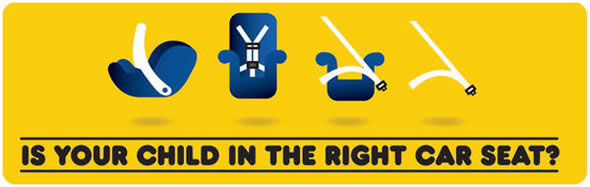
  • Is Your Child In The Right Car Seat?

    Is your child in the right seat?

    Every 33 seconds, one child under the age of 13 is involved in a crash. Many times deaths and injuries can be prevented by proper use of car seats, boosters, and seat belts.

    Child Passenger Safety Week: September 17-23, 2017
    National Seat Check Saturday: September 23, 2017

  • Water Safety Now! Part I

    In Virginia, drowning is the fifth leading cause of unintentional deaths.

    Some horrific statistics released this week noted that failing to observe water safety has cost the lives of 10 children at New Jersey beaches, lakes and pools already this summer. These are terrible tragedies and our hearts go out to the families of the children who drowned.

    The latter is especially tragic as in almost every case, accidental drownings are preventable. While swimming can be fun, swimming alone is dangerous. Children need watching, children around water need buddies and watching! Beach swimmers need to observe the rules of the beach, especially if there is no lifeguard present. No lifeguard, no swimming!

    It’s pretty simple. Swimming in the ocean where people may be unaware of rip currents or strong waves is dangerous. People, especially children, need to be taught to avoid water where there are rip currents, and if caught unawares, how to react to and survive them.

    Running and jumping or diving in a pool with a hard or cement bottom–especially if you don’t know the depth of the pool–can make swimming dangerous and unsafe. Children need to be taught NOT to run and dive or jump at a public or backyard pool or to jump in pools where other children are already swimming.

    Accidents around water happen fast!

    Leaving children alone in bathtubs, spas, hot tubs or pools is a mistake that parents and caregivers should not make. It can and has cost children their lives. Never leave kids alone in or near water, no matter how shallow! A child can drown in water 3 inches deep.

    Swimming in lakes, rivers or ponds where people are unaware of  possible covered physical barriers under the water, the depths of the water, strong currents, the proximity of dams, bridge supports, drains, rocks, boat docking equipment or pipes under the water, can be very dangerous. More than two years ago 6 year old Asa Gayle from Richmond, Virginia, drowned at Lake Anna, Virginia, after falling from the dam while fishing with her grandparents and sister. The suction from the dam pulled her under and she drowned despite multiple attempts by family and rescuers to help her. Swimming, jumping or fishing where signs say “No SWIMMING, JUMPING or FISHING” is a bad, unsafe idea. Around the water, signs and rules must be obeyed, because accidents happen fast–and often there is no time for more explanation!

    Knowing the type of river, lake or pond bottom (weeds, sand, rocks, etc.) or whether there are wildlife in the area are also important in order to avoid accidents. So there are things, which, depending upon the area and the type of water your child is swimming in, that can make swimming a potentially dangerous sport. There are not only live critters like fish, eels, beavers, snakes, turtles and more in lakes, rivers and ponds…there are miniscule critters called bacteria, mildew and pollen floating in so-called “fresh” water. And there is “poop” from fish, birds and waterfowl. If the lake, river or pond borders farmland, you may even see excrement from farm animals floating–not a pleasant site and best left alone. And there is also Naegleria fowleri, the brain-eating amoeba found in swamps, ditches, ponds, lakes and rivers. So if you don’t know what’s in the water, it’s best NOT to take in water by swallowing it, or allowing it go up your nose. (In our family, we always followed the don’t-get-your-head-wet rule, if it were possible.) by using nose plugs, the finger-pinch method or goggles that cover your face/nose. Discourage children from “ducking” swimming pals! This, too, can have disastrous results.

    There is another danger that previously I did not know existed and this is why I am sharing it with parents and caregivers now–because it is scary! There can be at marinas, docks and boatyards on freshwater lakes and rivers, danger from leaking electrical current if ground faults have not been properly installed or maintained. There have been a number of drowning deaths at marinas where electrical shock has caused swimmers to drown. The first rule is DON’T SWIM AT MARINAS where electrical current has been run to docks for the purpose of boat repair, etc. Respect the signs  at marinas that say either “NO SWIMMING” or “DANGER! No Swimming, No diving!” etc. Those signs are there for a reason! So Never Swim at Marinas, Docks or Boatyards!

    If parents have a pool in their backyard, supervise your child while swimming!–you might want to even invest in a ShockAlarm which gives a warning sound when electrical current has entered your pool area! And there is a pool alarm which lets you know that a child or person is in your pool! Good investments in safety, like wearing life jackets, using proper flotation devices and installing pool and shock alarms–always pay off!
  • It’s So Hot… Please help prevent HOT CAR DEATHS!

    July 31 is National Heat Stroke Prevention Day!

    The National Highway Transportation Safety Administration and SafeKids are teaming up to get the word out about heat stroke this season. As the temperatures rise, so do the number of hot car
    injuries and deaths. Children, the elderly and the infirm are of primary importance and at great risk. Temperatures in parked cars with the windows up rise in seconds! You need to know
    the following in order to help:

    “A child dies from heatstroke about once every 10 days from being unattended in a hot vehicle. In fact, heatstroke is the leading cause of non-crash vehicle fatality for kids 14 and younger. In more than half of these deaths, the caregiver forgot the child was in the car or the child climbed into an unlocked car to play and couldn’t get themselves out. These tragedies are 100-percent
    preventable!”

    The National Highway Traffic Safety Administration (NHTSA) and Safe Kids Worldwide are asking people to help raise awareness about the danger of heatstroke to kids in cars through social media conversation this summer. We are reaching out to the community to get the conversation started and keep the momentum going on Twitter on July 31, every 30 minutes starting at 7 a.m. EDT – @NHTSAgov will be using the hashtags #heatstrokekills and #checkforbaby on all of its social media posts (including Instagram and Facebook) and asks you to help us take action.

    Please pass on to friends with children to place a reminder in the front seat if they are driving with a child in the back seat…that a child is there. Whether it’s a child’s toy or a sign on the dashboard… or put your purse or a needed briefcase in the backseat too, so you have to look in the back before you leave the car and remember your child is there. Don’t be a distracted driver, don’t use your cell phone while driving and DO one last backseat check after you park to make sure there is no child in that vehicle.

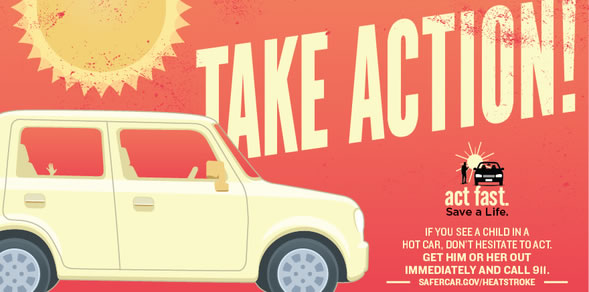
    Others… if you see a child in a backseat with the windows rolled up (a.c. or no, car running or not), call 911. Children are not to be left alone in parked cars…for any reason!

  • If A Child Is Missing, What Should You Do?

    Children playing hide and seek is nothing new, but when your child disappears whether it’s from your home, your yard, their school, or in a store or a public place, like a park or shopping center, then it’s an urgent concern. The first thing to do if you are sure your child is missing–and it’s difficult for any parent or responsible person caring for a child when you become aware your child is actually missing–is to KEEP CALM! But you can’t think in a turmoil and you must think, about where and when you saw your child last. The next thing is ASK FOR HELP, from a neighbor, close friend, store manager or other authority present, and CALL 911.

    If you are at home, check areas of greatest concern first, areas where a child could run into big trouble: closets, old appliances such as a basement refrigerator or freezer, under beds, in an automobile trunk or down in the seat well or backseat of a car. Check bathtubs, “hot” tubs, shower stalls, hampers, blanket boxes–anywhere your young child could fit or climb in to hide. Check the attic and/or the basement, if you have one, garage and storage areas as well.

    If your child is missing from out of doors, after checking around the outside of the home, including shrubbery, outbuildings if any, and the street, call any possible playmates’ parents or babysitter(s) immediately. If you come up empty after a few minutes’ initial checks, then contact your local police department immediately: CALL 911.
    Don’t wait. Minutes matter! Finding your child is often best left to professionals, they are trained to know where to look.

    When reporting your child missing, provide a recent photo of your child to the authorities, so they know what the child they are looking for looks like. Make sure to provide them your child’s gender, height, weight, hair color and age on their last birthday and what your child was wearing when you saw them last, and if he or she has any particular noticeable physical traits or birthmarks or missing teeth. Provide any important information about health conditions, such as autism, Down syndrome, ADHD, or any current health issues. Provide the police with names of playmates, favorite outdoor play areas and your child’s habits and hobbies. If they ride their bikes, skateboards or scooters, where? Do they play in a wooded area or a school or community playground, or a vacant building lot? Are there ponds or swimming pools, rivers, lakes or any other bodies of water nearby, where they might go? It is very important that areas that could create extreme danger for a child be checked immediately. If you live in the city, nearby busy streets, abandoned buildings or vacant lots, public parks, school yards in or close to your neighborhood are such areas.

    In a store or shopping center if your child is missing, immediately contact the store’s manager, inform them where you saw your child last and provide vital information and a recent photo of your child. The store manager will initiate a check of the immediate area and contact the police if the child is not found within a few minutes. With many people having cell phones and taking photos, it’s good to keep that recent photo of your child on your cell phone so you can download and send it easily to security and police personnel looking for your child.

  • Toddler suffers serious burns to his feet at splash pad

    On a very hot day in a Greenwood, IN, public park, a young toddler walked away from his mother onto the “splashpad” made of an asphalt like material.  The child began screaming and the mother ultimately put his shoes back on and took him to the doctor’s. He suffered 2nd Degree burns on the bottoms of his feet.​  Park officials are now warning parents that on hot days, ground surfaces will heat up!

    Read the article at AOL News

  • Vehicle Heatstroke Prevention

    Take Action
    Heatstroke is the leading cause of vehicular non-crash-related deaths for children under 14. In fact, each year, an average of 37 children have died from vehicle heatstroke between 1998-2015.

    While it seems like an impossible mistake to make, every parent or caregiver can potentially become distracted, and distractions often fuel this devastating situation.

    No one is immune. Yet, this tragedy is 100% preventable.

    We each have a role to play to help keep our kids safe. Help us share live-saving tips and resources with as many people as we can.

  • Safe Kids Day

    At Safe Kids Worldwide, protecting kids is both our mission and an urgent call to action. Preventable injuries are the #1 killer of kids in the United States and almost every one of these tragedies is preventable.

    Safe Kids works in communities across the U.S. and in more than 30 countries globally to reduce traffic injuries, drownings, falls, burns, poisonings and more.

    Safe Kids Day is an annual fundraising campaign to support the life-saving programs of Safe Kids Worldwide and our local coalition partners. We need your help now more than ever. Please give generously and help protect kids on the road, at home, and at play.

    Safe Kids Day

  • Are Our Cities Safe… for Children?

    Dedicated to the Memory of Lavontay White, 2 years old. – Deceased

    I used to think of this Country as the safest country in the world. I still try to think of it that way, but for children in our inner-cities, I am not convinced. In Chicago, in the past few days, there have been several child fatalities caused by gun violence. The youngest child killed was 2 years old and his name was Lavontay White. The manner of his death is unacceptable to me… and should be to everyone in this Country. And, sadly, Lavontay’s death is only the tip of the iceberg!

    If people are protesting, maybe they should take the time to protest the fact that children are being killed by gun violence in our inner-cities–whether it’s due to gang violence, or drugs and the crime drugs bring to communities, or cultural and economic disparities–it doesn’t matter, the result is still the same.

    Children are dying, caught in the crossfire or intentionally killed. The lights of the most vulnerable among us– and the hope for this Country’s future– are being senselessly put out–and it’s wrong.

    What if it were your child or grandchild? What if it were mine? It seems the severity of punishment for such crimes is not enough to deter the worst bad actors. So, what are the next steps our cities’ mayors, and child and human rights advocates, must take to cure this most sick of societal ills? Do they have a plan? Is preventing harmful gun violence to children a priority on anyone’s agenda? Do children need to be removed from the crime-ridden cities to safe spaces until gun-toting gangs are eliminated and drug dealing thugs can be incarcerated? Please, will you tell me?