Category: Childrens Health
-
Serious Measles Outbreaks Focus Attention on Those Without Vaccinations
Recent outbreaks of measles in the Philippines, Madagascar and Japan have taken their toll. Lives are at stake! Diseases we, in America, consider practically to have been eradicated are popping up again in other countries and in our own! Immunizations can prevent childhood deaths.
The outbreaks of measles that occurred in Seattle, Manila, Madagascar, and Japan could have been averted had people–especially children–received the vaccine(s). February 7, 2019, Jason Gutierrez, of The New York Times, reported of the Philippines: “The Department of Health said that measles had killed 55 children age 4 or younger at San Lazaro Hospital in Manila since the start of the year.” (New York Times, 02/07/2019)
The Guardian reported: “as of December 2018, there were more than 20,000 reported measles cases in the Philippines, a 500% increase on the year before.” And, “in the Philippines, vaccinations are currently only at 55% according to UNICEF, down 15% on last year. This has been blamed mainly on fear-mongering over inoculations.” (The Guardian, Hannah Ellis-Petersen, 2/12/2019) At last count, there have been 203 deaths due to measles in the Philippines. (Outbreak News Today, 2/24/2019)
Newsweek published the following: “Last month, … the World Health Organization declared “vaccine hesitancy” as one of the major global health threats in 2019, with a noted 30 percent increase in global incidence of measles. It’s believed that the anti-vaccination sentiment was what led to measles outbreaks in Oregon, New York, Texas, Washington and elsewhere in the U.S.” (“Anti-Vax Religious Group Says Sorry for Helping Cause Massive Measles Outbreak”, Newsweek, Tom O’Connor, 2/21/2019)
In the U.S., it’s not only the reticence to get measles vaccinations that threatens children, at this writing, the flu is so serious in New Jersey, three children have died due to flu. “Schools have had to close as NJ’s flu scare has become ‘widespread,’ and the number of test cases have quadrupled over the past 2 months.” A dangerous strain that caused a 2009 pandemic has re-emerged in New Jersey, according to the state’s Department of Health. (New Jersey (Ridgewood-Glen Rock) Patch, Tom Davis, Patch National Staff, 2/26/19)
Physicians and scientists are also in a quandary over another health challenge called Acute Flaccid Myelitis (AFM)–prevalent in children–which seems to mimic polio in some respects. In 2018, there were 215 confirmed cases of AFM which occurred in 40 states across the U.S., the number of which appeared to spike in August-September, according to the CDC. So, if a vaccine is developed to check more diseases, like AFM and others, will our children– and the population at large– continue to be at risk–if parents don’t allow children to be vaccinated?
-
Children, the Flu, and the Flu Vaccine
Children, especially those younger than 5 years, are at higher risk for serious flu-related complications. The flu vaccine offers the best defense against getting the flu and spreading it to others. Getting vaccinated can reduce flu illnesses, doctor’s visits, missed work and school days, and prevent flu-related hospitalizations and deaths in children. Information on this page summarizes vaccine recommendations for children. Visit this page to learn more about vaccine benefits.
Note: Frequently Asked Flu Questions 2017-2018 Influenza Season for flu and flu vaccine information specific to the current flu season.
Influenza is dangerous for children
Influenza (“the flu”) is more dangerous than the common cold for children. Each year, millions of children get sick with seasonal influenza; thousands of children are hospitalized and some children die from flu.
- Children commonly need medical care because of influenza, especially before they turn 5 years old.
- Children younger than 5 years and especially those younger than 2 years are at high risk of serious influenza complications.
- Children of any age with chronic health problems like asthma, diabetes and disorders of the brain or nervous system also are at high risk of serious flu complications.
- Flu seasons vary in severity:
- CDC estimates that since 2010, flu-related hospitalizations among children younger than 5 years ranged from 7,000 to 26,000 in the United States.
- While relatively rare, some children die from flu each year. Since 2004-2005, flu-related deaths in children reported to CDC during regular flu seasons have ranged from 37 deaths to 171 deaths. Information about pediatric deaths since the 2004-2005 flu season is available in the interactive pediatric death web application.
The single best way to protect your children from the flu is to get them vaccinated each year.
The seasonal flu vaccine protects against the influenza viruses that research indicates will be most common during the upcoming season. Traditional flu vaccines (called “trivalent” vaccines) are made to protect against three flu viruses; an influenza A (H1N1) virus, an influenza A (H3N2) virus, and an influenza B virus. In addition, there are flu vaccines made to protect against four flu viruses (called “quadrivalent” vaccines). These vaccines protect against the same three viruses as the trivalent vaccine and an additional B virus.
What kinds of flu vaccines are available for children?
Influenza vaccine options for the 2017-2018 season are listed in “TABLE: Influenza vaccines — United States, 2017–2018 influenza season. Different products are approved for different age groups, including children as young as 6 months of age.
Note that while there is a quadrivalent nasal spray vaccine that is FDA approved for the U.S. market, ACIP and CDC recommend that nasal spray vaccine not be used during the 2017-2018 season because of concerns about how well it works.
Your child’s health care provider will know which vaccines are right for your child.
- CDC recommends that everyone 6 months of age and older get a seasonal flu vaccine.
Keep in mind that vaccination is especially important for certain people who are high risk or who are in close contact with high risk persons. This includes children at high risk for developing complications from influenza illness, and adults who are close contacts of those children.
For the complete list of those at high risk, visit People at High Risk of Developing Flu–Related Complications.
There are special vaccination instructions for children aged 6 months through 8 years of age
Some children 6 months through 8 years of age require two doses of influenza vaccine. Children 6 months through 8 years getting vaccinated for the first time, and those who have only previously gotten one dose of vaccine, should get two doses of vaccine this season. All children who have previously gotten two doses of vaccine (at any time) only need one dose of vaccine this season. The first dose should be given as soon as vaccine becomes available.
The second dose should be given at least 28 days after the first dose. The first dose “primes” the immune system; the second dose provides immune protection. Children who only get one dose but need two doses can have reduced or no protection from a single dose of flu vaccine.
If your child needs the two doses, begin the process early. This will ensure that your child is protected before influenza starts circulating in your community.
Be sure to get your child a second dose if he or she needs one. It usually takes about two weeks after the second dose for protection to begin.
Recommendations on the control and prevention of influenza are published annually, in late summer or early fall. Existing recommendations are available at Seasonal Influenza Vaccination Resources for Health Professionals.
Some children are at especially high risk
Children at greatest risk of serious flu-related complications include the following:
- Children younger than 6 months old
These children are too young to be vaccinated. The best way to protect them is to make sure people around them are vaccinated. - Children aged 6 months up to their 5th birthday
Since 2010, CDC estimates that flu-related hospitalizations among children younger than 5 years ranged from 7,000 to 26,000 in the United States. Even children in this age group who are otherwise healthy are at risk simply because of their age. Additionally, children 2 years of age up to their 5th birthday are more likely than healthy older children to be taken to a doctor, an urgent care center, or the emergency room because of flu1,2,3. To protect their health, all children 6 months and older should be vaccinated against the flu each year. Vaccinating young children, their families, and other caregivers can also help protect them from getting sick.
1CDC Influenza Vaccine Program Impact Report 2015-2016
2Bourgeois F, Valim C, Wei J, et al. Influenza and Other Respiratory Virus–Related Emergency Department Visits Among Young Children. Pediatrics 2006; Volume 118 /Issue 1
3Poehling K, Edwards K, Weinberg G, et al. The Underrecognized Burden of Influenza in Young Children. The New England Journal of Medicine 2006; 355:31-4 - American Indian and Alaskan Native children
These children are more likely to have severe flu illness that results in hospitalization or death.4,5
4CDC. Deaths Related to 2009 Pandemic Influenza A (H1N1) Among American Indian/Alaskan Natives — 12 States, 2009. MMWR. 2009;58(48);1341-1344.
5CDC. Prevention and Control of Influenza with Vaccines: Recommendations of the Advisory Committee on Immunization Practices (ACIP), 2010. MMWR. 2010; 59(No.RR-8). - Children aged 6 months through 18 years with chronic health problems, including:
- Asthma
- Neurological and neurodevelopmental conditions [including disorders of the brain, spinal cord, peripheral nerve, and muscle such as cerebral palsy, epilepsy (seizure disorders), stroke, intellectual disability (mental retardation), moderate to severe developmental delay, muscular dystrophy, or spinal cord injury].
- Chronic lung disease (such as chronic obstructive pulmonary disease [COPD] and cystic fibrosis)
- Heart disease (such as congenital heart disease, congestive heart failure and coronary artery disease)
- Blood disorders (such as sickle cell disease)
- Endocrine disorders (such as diabetes mellitus)
- Kidney disorders
- Liver disorders
- Metabolic disorders (such as inherited metabolic disorders and mitochondrial disorders)
- Weakened immune system due to disease or medication (such as people with HIV or AIDS, or cancer, or those on chronic steroids); and
- Children who are receiving long-term aspirin therapy
Children should be vaccinated every flu season
Children should be vaccinated every flu season for the best protection against flu. For children who will need two doses of flu vaccine, the first dose should be given as early in the season as possible. For other children, it is good practice to get them vaccinated by the end of October, if possible. However, getting vaccinated later can still be protective, as long as flu viruses are circulating. While seasonal influenza outbreaks can happen as early as October, most of the time influenza activity peaks between December and February. Since it takes about two weeks after vaccination for antibodies to develop in the body that protect against influenza virus infection, it is best that people get vaccinated so they are protected before influenza begins spreading in their community.
Additional Information:
- CDC Reports About 90 Percent of Children Who Died From Flu This Season Not Vaccinated March 22, 2013
- Children with Neurologic Disorders at High Risk of Death from Flu August 29, 2012
- CDC Report Details Influenza Prevention and Treatment for Children and Teens September 15, 2011
- Frequently Asked Flu Questions 2017-2018 Influenza Season
-
Flu season is coming! #FightFlu and protect yourself and your loved ones with a flu vaccine this season
 Flu season is just around the corner, which means it’s time to get your annual flu vaccine. Get a flu vaccine for yourself and your family before the end of October, if possible.
Influenza, also known as flu, is a contagious respiratory disease that infects the nose, throat, and lungs. Flu can be a serious disease that can lead to hospitalization and even death. Every flu season is different, and flu viruses can affect people differently. It’s important to remember that even healthy people can get the flu, and spread it to others who are more vulnerable to serious flu or flu-related illness. Those with health problems, adults 65 years and older, and young children, for example, are at high risk of becoming seriously ill from flu.
Every year in the United States millions of people become sick, hundreds of thousands are hospitalized, and thousands to tens of thousands of people die from the flu. A typical flu season in the U.S. can begin as early as October and can last as late as May.
Flu vaccination is the first (and best) way to protect against flu each year. September 28, 2017, marks the annual kickoff of the flu awareness campaign led by the Centers for Disease Control and Prevention (CDC), the National Foundation for Infectious Diseases (NFID), and many other partners working together to protect people from flu. The campaign emphasizes the importance of annual vaccination for everyone age 6 months and older, and raises awareness about the potential dangers of flu.
#FightFlu this season by getting yourself and your loved ones vaccinated today! You can help spread the word by sharing this flu vaccination message on your social media channels.
How to show your support:
1. Join the Thunderclap.
Select social media channel(s) to share the Thunderclap message.
Authorize Thunderclap to use your account. (This is necessary in order for Thunderclap to be able to count your followers, which helps increase the reach of our campaign, and send out a one-time message on September 28, 2017.)
Watch #FightFlu on September 28 as Thunderclap participants proclaim their unified support for annual flu vaccination.
2. Spread the Word.
Share how you plan to fight flu this season on social media with the hashtag #FightFlu, and encourage your followers to do the same. Original pictures or videos with #FightFlu may be shared from @CDCFlu’s Twitter profile!
3. #FightFlu
Get your flu vaccine and spread the word to encourage others to do the same.
For more information about flu and flu vaccination, please visit www.cdc.gov/flu and www.nfid.org/flu and be sure to follow us on Twitter: @CDCFlu and @NFIDvaccines.
-
Flu Deaths in Children Exceed 100 for 2016-2017
This is not a statistic I like to relate to readers of this blog: 101 deaths in children from flu-related causes have been reported to the Centers for Disease Control and Prevention for 2016-2017–and these are the deaths which have been reported.
There may have been some deaths where causes were not readily discernible or were more complicated, or possibly not diagnosed and not reported as flu-related deaths. Flu shots, according to a recent study, are still the best deterrent to kids getting the flu and bringing it to school or bringing it home from school and spreading the flu. We are now less than two months away from the new school year’s start, and while we don’t offer medical advice in this blog, we encourage parents to get the facts on the flu and consider having their children receive whatever current flu vaccine shots are available when the time comes to help retard the spread of the flu and keep kids and families safe. “CDC recommends an annual flu vaccine for everyone 6 months and older. Influenza vaccination rates among children (6 months to 17 years) have been around 60% for the past several seasons.” 1
According to the CDC, during the 2012-2013 and 2014-2015 flu seasons, the Influenza A (H3N2) virus predominated. That strain of the virus is generally associated with more difficult outcomes in children and the elderly. A recent CDC study (published in Pediatrics) has confirmed that flu vaccine can prevent flu-related deaths in children and “can reduce the risk…by 51%” 2
This is impressive and makes it a no-brainer for me that it’s important to get a shot and be protected.
___________________
1 https://www.CDC.gov/flu/news/reported-flu-deaths-children.htm,
June 23, 2017, Centers for Disease Control and Prevention, National Center for Immunization and Respiratory Diseases (NCIRD),
1600 Clifton Road, Atlanta, GA
30329-4027 USA2 Ibid.
-
Measles and Keeping Kids Safe
Most seniors, those over age 55 in the U.S. population, remember measles, mumps and rubella. Today, many family physicians have never seen cases of measles numbering in the double digits in their practice areas, town and city school districts, as were observed in the 1950s and early 1960s before the MMR vaccine became fully available. Everyone living in the United States today is fortunate to be able to put measles as a major health threat behind them, so far. Children growing up in the 1950s and ‘60s lived with the knowledge that if their school friends had measles, they would most likely get the disease too! At that time, it meant at least one week in bed and out of school–with no visitors except your parent caregiver (usually your mother), and she couldn’t leave the house either, because the family would be quarantined.
But thanks to scientific research and the work of many great physicians, scientists, virologists, and epidemiologists, children living in the U.S. had first the measles vaccine in 1963. Before that time, however, as noted by the Centers for Disease Control in their history of measles, by the time they were 15 years old, nearly all children had experienced the measles. CDC estimates at that time, “3 to 4 million people in the United States were infected each year,.. an estimated 400 to 500 people died, 48,000 were hospitalized, and 4,000 suffered encephalitis (swelling of the brain) from measles.” 1 Early in the 20th century, the prognosis was far worse, an estimated 6,000 people died from measles each year in the U.S. 2
What is Measles? Simply, measles is a highly contagious virus, causing respiratory infection, runny nose, fever, red eyes, cough, and a generalized red rash. Coughing, sneezing airborne secretions of mucus and saliva and close personal contact will spread the measles. CDC also points out that every year people who either haven’t been vaccinated and who travel are often exposed to measles, and they can carry the disease from wherever they were exposed into the U.S. So it’s good for most travelers to have been vaccinated (with MMR vaccine) before traveling to places where measles still exists, so they do not contract the disease and spread it to others. Having experienced measles as an adult at 28 years of age, I corroborate that this is not a disease you want to get, and the older you are, the more uncomfortable and dangerous it can be.
In 2011, 220 people in the United States were diagnosed with measles. Despite the success of eliminating measles by vaccinating people, outbreaks still occur. Some parents have questioned whether the MMR vaccine causes autism–and this concern still lingers and is being studied–despite the fact that there have been repeated studies which indicate otherwise. Yesterday, it was announced in the press 3 that a 7-month old infant in northern New Jersey has contracted measles and may have exposed others between January 17 and 23. The child was treated in hospital and is recovering at home. The hospital is contacting people who may have been exposed in the hope to head off any spread of the disease. It is important that parents and caregivers understand the benefits of vaccinating their children. We must think not only of our own families but of those around us, and be good stewards of community health and be aware of preventive measures that keep families and children healthy and safe.
__________________
1Centers for Disease Control and Prevention,1600 Clifton Road Atlanta, GA 30329-4027 USA, www.cdc.gov/measles/about/history.html
2Ibid.
3Ridgewood Patch, “North Jersey Baby Diagnosed with Measles: State Health Officials”, Hubbard, Daniel, January 30, 2017. http://patch.com/new-jersey/ridgewood/s/g0ltz/north-jersey-baby-diagnosed-with-measles-state-health-officials -
Girls now begin consuming alcohol at a younger age than boys!
The National Institutes of Health have just released a study on April 12, 2016. This is something for parents of young children to note…as underage drinking by sibling teens affects every member of the family–especially young children. The full article is at www.nlm.nih.gov/medlineplus/news/fullstory_158269.html
-
March is Poison Prevention Month!
March is Poison Prevention Month, and there are some recommendations that parents, family members and caregivers should know and follow to prevent childhood poisonings, especially related to medicines and household products! Unintentional injuries are a leading cause of death in young children. Common unintentional injuries are suffocation, drowning, poisoning, fire/burns, falls, and sports-related injuries and, of course, injuries caused by motor vehicles. For the purpose of this blog posting, we will concentrate on how to prevent child poisonings, especially those related to household products and medicines.
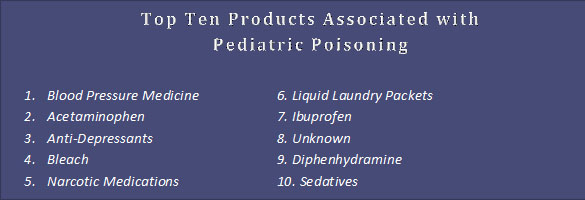
(Source: CPSC.gov)First, the U.S. Poison Control Center’s telephone number should be accessible near your landline phone and/or in your speed dials or list of emergency contacts on your cell or smart phone. The number should be easily visible to anyone including your child’s caregivers or babysitters! The number is: 1 (800) 222-1222. This phone line is open and staffed 24 hours a day, 7 days a week! If you suspect a poisoning, call the Poison Control Center, stay on the phone and follow the instructions you are given.
ALL medicines and household products (including the items you would normally keep in a medicine cabinet or medicine chest and cleaning products, laundry detergents, household chemicals of all kinds, etc.) SHOULD BE STORED UP HIGH, OUT OF SIGHT, preferably in a LOCKED CABINET. Children–even young children–are climbers, they are curious, they pull things down on their heads they can barely reach.
If you take medicine, do not place your medicine on the table, counter or night table, where a child might see it and think it is candy, reach and possibly swallow it.
If you take or give medicine to a child at night, TURN ON THE LIGHT, so you can see that you are taking or giving your child the proper dosage.
If you must do something else while you are in the process of taking medicine–like answering the phone or going to the bathroom–take your young children with you and don’t allow yourself to be distracted when medications are present. Make sure to secure child safety caps every time you open and close your medicine bottle or container. And put the medicine away after use, up high, where your child CANNOT reach it.
The U.S. Centers for Disease Control and Prevention also recommends that you learn if any guests visiting your home and bring in medicines or drugs, legal or illegal, ask guests to store their medicines where children cannot get to them. Don’t take or give larger doses of medicine to your child than are prescribed by your family physician. Follow the directions on the label, and if you have questions, call your pharmacist, your child’s primary care provider, or your doctor’s office before administering the medicine!
-
Measles Again!
The source for this information was a news release by ABC/7 with input from the Florida State Health Department1, because it is one of the best summaries I have read of what people, especially parents, caregivers and family members, need to know for their children’s and the general public’s safety, with regard to Measles.
Spring is coming and so is the occasional measles outbreak. Measles was essentially conquered in its endemic form by rigorous vaccination programs since 1963, and seemed eradicated in the United States by 2000. The medical community has not seen it in widespread outbreaks in the past few years, as badly as in days prior to the the use of Measles vaccine (now known as MMR, Measles, Mumps and Rubella Vaccine). But there have been outbreaks in California, Florida, New England, Washington, D.C., and Branson, MO, and the medical community expects there may be outbreaks this year which are not necessarily due to infected travelers or unvaccinated people who have become infected and entered the U.S. Again, this news release is one of the most clearly written about Measles that I have seen and it may help parents and caregivers to read it now before measles rears its ugly head again this spring! (Omitted are the statistics about Florida infections in 2015, merely to save space.) Please take a read:
“Measles is a serious respiratory disease caused by a virus of the same name (Measles). The disease is highly contagious and can spread to others who are unvaccinated.
“We applaud all who have gotten vaccinated or confirmed their immunity in light of the unfortunate cases of measles in Florida this year”, said State Surgeon General and Secretary of Health Dr. John Armstrong. “Vaccination remains the best way for Floridians and visitors to protect their children, themselves and their communities from what is ultimately a serious yet preventable illness.”
People who are particularly susceptible are pregnant women, infants under the age of 12 months and people who are immunocompromised.
Vaccinations are available year round through health departments [in Florida’s 67 counties] or your local doctor’s office. The department encourages all residents and visitors who have not been immunized to get vaccinated immediately, according to health officials.
The department says it continues to work with community health care and governmental partners in sharing the facts about measles and the benefit of being vaccinated.
The MMR (measles, mumps and rubella) vaccine is about 97 percent effective if both scheduled doses are received. This means about three out of every 100 fully vaccinated persons may still be affected, according to health officials.
________________
1 News release by ABC/7 with input from the Florida Health Department, April 24, 2015, on Measles.
-
Everyone is talking about… Zika
It’s important, today, especially for pregnant women that we are discussing Zika. Zika is not a who, but it definitely is a “what”! Zika is a virus, and it is carried and spread by the bite of a particular mosquito infected with the virus, the Aedes aegypti mosquito. This is the mosquito also known as the carrier of Yellow Fever, the Dengue viruses, and the very same mosquito which can carry and spread the Chikungunya virus. It is important for us to be able to identify this mosquito, which is black with tiny white markings on its head, back, legs and a lyre-like white marking on its thorax… if you get that close enough to see it! Here is a link with a very good photo of Zika (and we must give credit to ABC News for publishing this photo, it is excellent!)1 http://abcnews.go.com/Health/florida-gov-declares-state-emergency-counties-zika-virus/story?id=36696887 For obvious reasons, this is a mosquito we don’t want in or around our homes or in places we go. At least in the United States, we expect mosquito prevention and eradication measures, such as pesticide spraying, may be stepped up by appropriate state or federal agencies where the zika virus is present.
The disease itself has symptoms ranging from fever, to rash, joint pain, and conjunctivitis (red eyes). The symptoms may be mild and last several days to a week. But the effects of Zika virus in pregnant women are most troubling and they include microcephaly, a birth defect, in the offspring of pregnant women who become infected with the virus while they are pregnant. Microcephaly means that the circumference of the head of a (newborn) child is more than two standard deviations below average size for the age and sex of a child. Simply put, the virus may cause a child’s head not to be fully developed in size if his or her mother was infected with the virus while she was pregnant with that child.
Before 2015, Zika virus outbreaks occurred in Africa, Southeast Asia, and the Pacific Islands, but the virus is now heavily present in Central and South America (although not in Chile). It is also in the United States, but not yet in Canada. The CDC and the World Health Organization note that the virus’ spread is rapidly on the increase in various countries. Governor of Florida Rick Scott has declared a health emergency in Florida as several cases of Zika have been identified and isolated there. One theory being checked also is that the disease may have been sexually transmitted, from an infected partner to another person. Although this has not yet been fully confirmed, taking precautions, especially if you are pregnant and you are traveling or have traveled to areas where Zika is present, is a very sound idea. Pregnant women are recommended not to travel to areas where the zika virus exists presently. If you are already in those areas you are encouraged to wear long-sleeved shirts, long pants and socks which cover your skin in order to prevent a bite. Stay in places where there are windows and door screens. Pay attention to instructions for applying insect repellents. There are special instructions for the use of insect repellents with children. To be more informed about this disease, please visit CDC’s Fact Sheet on Zika at cdc.gov/zika/disease-qa.html
There is currently NO Vaccine yet developed or specific treatment advised for the Zika virus.
_______________________
1 ABC News, “Florida Governor Declares State of Emergency in Counties with Zika Virus”, February 3, 2016, ABC News, 47 West 66th Street, New York, NY 10023,http://abcnews.go.com/Health/florida-gov-declares-state-emergency-counties-zika-virus/story?id=36696887